
2026-11-02 · 7 min read
A 1.47 m Fiberglass Bottle Prop for a Skincare Range
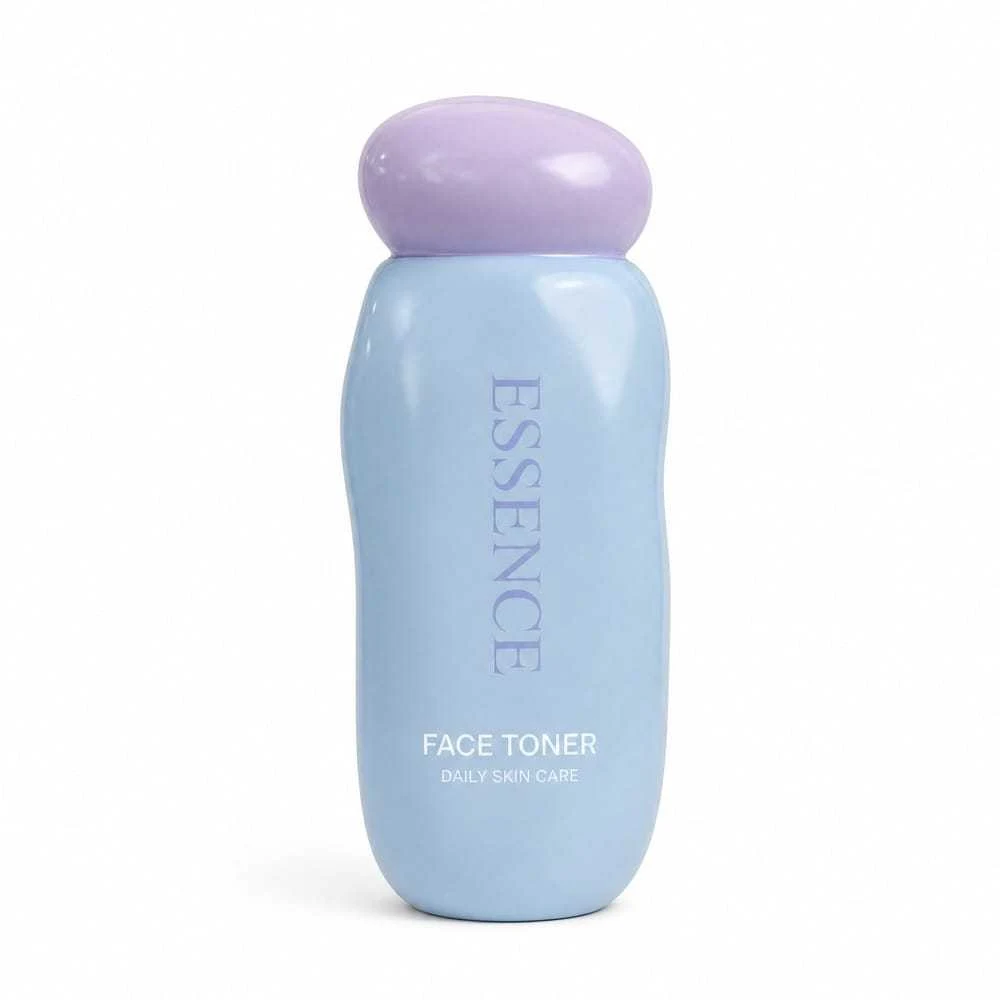
A toner bottle is a shape people already know. That is the problem and the advantage: at 1.47 m it is recognised from across a shop floor, and every proportion that is slightly off is recognised just as fast. At this size the piece stops reading as packaging and starts reading as an object, so three things decide whether it works — the shoulder line, the label panel, and the cap.
The shoulder is where a scaled bottle gives itself away
A toner bottle tapers from a wide body into a narrow neck. Scaled up naively, that taper flattens and the piece starts to look like a jug. The body here is moulded in fiberglass as a single form, with the shoulder and neck taken off the original container rather than redrawn by eye. Working from the client's own pack is the difference between a prop that is recognisably their bottle and one that merely resembles a bottle — the same discipline we describe inscaling a cosmetic bottle to 1.52 m.
The label panel has to be flat and readable
Printed copy on an oversized prop is read from two or three metres away, which means a strongly curved panel distorts the lettering. The front face is kept flat enough that vertical type stays vertical. The copy itself is produced to the buyer's own artwork — we do not print a brand we do not own, and display pieces that leave our workshop either carry the client's approved artwork or ship blank for finishing on site.
The cap, and why it stays on
The cap is cast in resin, finished in gloss, and bonded to the body rather than clipped on. A detachable cap on a piece this tall is a handling risk: it gets lifted off in a warehouse, set down somewhere, and the prop arrives at the venue incomplete. Bonding it removes that failure mode.
The trade-off is crating — the piece travels as one unit, so the case is built around the finished height rather than around two parts that could be packed separately. Where a client needs a knock-down build for a tight venue or a shared container, that is a different structure and we would say so at quoting stage rather than after the drawing is signed.
Colour and finish
Colour is matched to the buyer's target rather than picked from a range, and it should be approved under the lighting the piece will actually live in. A shade signed off under office light reads differently under warm retail spots, which is why we ask where the piece is going before the colour is locked. Gloss and matte behave the same way: gloss throws highlights under window spotlights, matte absorbs them.
Shipping a one-piece prop
Body and resin cap are bonded, not knocked down, so the piece ships assembled in an export-standard crate sized to the full 1.47 m height. Cushioning is the part that matters here: a single rigid unit has no give, so the crate — not the model — is what absorbs transit damage. Whether the piece then needs fixings on site depends on the base specified; this build ships without a separate base or plinth, and the base question is settled at quoting stage against the actual venue.
Specs at a glance
| Height | 1.47 m (custom sizes available) |
|---|---|
| Body | Fiberglass, colour matched to buyer's target |
| Cap | Cast resin, gloss finish, bonded to the body (not detachable) |
| Structure | One-piece build; ships assembled |
| Installation | Freestanding; no separate base or plinth included |
| Minimum order | from 1 piece |
| Production lead | 25 days for the first 1–5 pieces |
Common questions
Can this be built at a different height?
Yes. 1.47 m is the size this page documents; other heights are built from the same specification sheet. What changes with height is the crate size and the handling, not the approach.
Is the copy on the body a real brand?
No. The lettering shown here is generic sample copy used to demonstrate the label panel. Production pieces carry the buyer's approved artwork, or ship blank to be finished on site.
Why is the cap not removable?
Because a loose cap on a 1.47 m prop goes missing between the workshop, the warehouse and the venue. Bonding it removes a failure mode at the cost of a slightly larger crate. If a knock-down build is needed for freight reasons, tell us before the drawing is finalised.
Does it come with a base?
Not by default — this build is a freestanding piece with no separate base or plinth. Tell us where it will stand, window, atrium or counter, and the base question is settled at quoting stage rather than after delivery.
Oversized cosmetic props are the part of retail display where proportion decides everything. If you are planning a launch or a counter takeover,send us the bottle you want enlarged and we will come back with feasibility, material and a quote. For the material decision itself, start withacrylic vs fiberglass for giant display props, or browse the full range ofgiant cosmetic replicas we build.