
2026-10-30 · 9 min read
Gold-Plated Cap and Faux Stones on a Factice
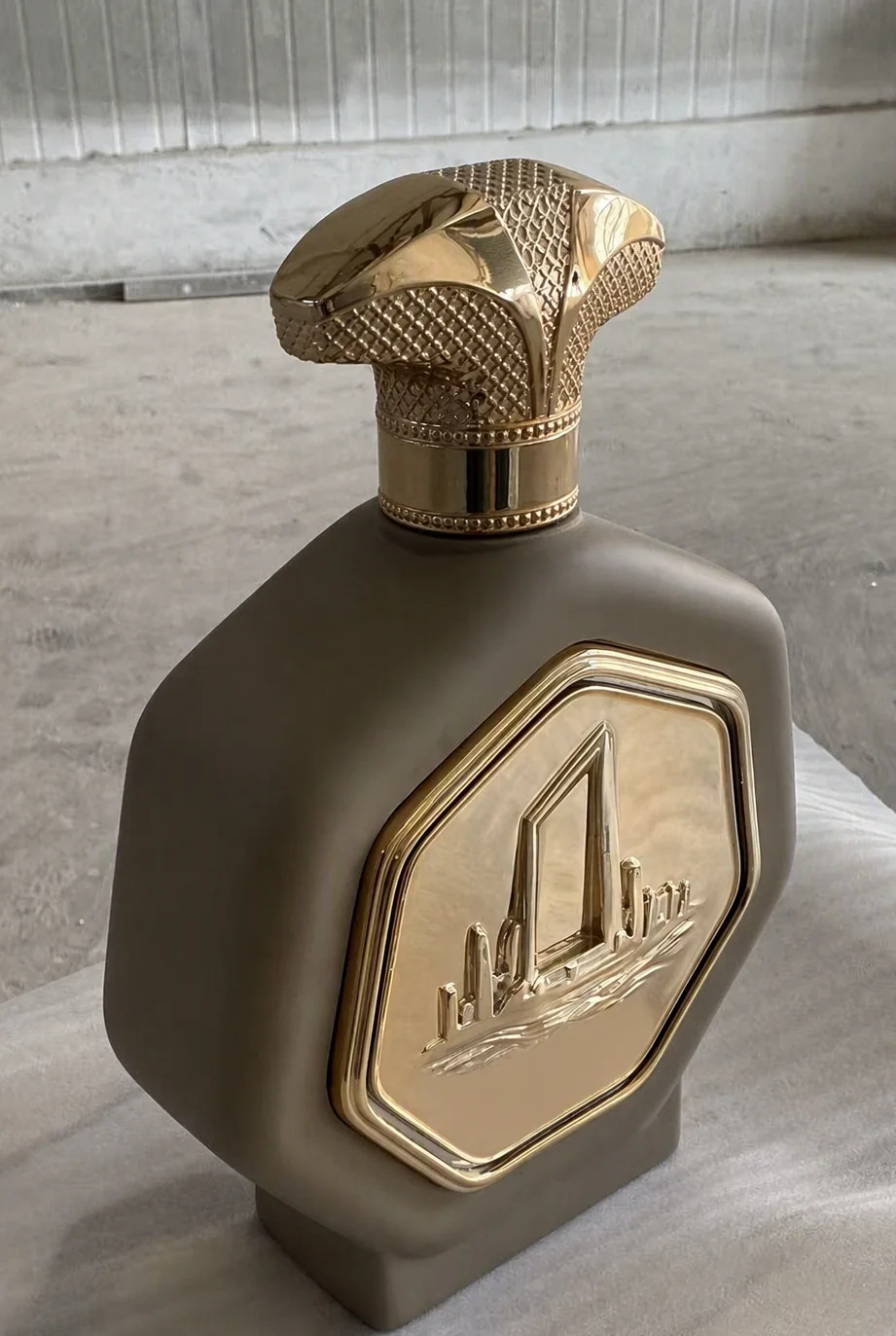
The piece stands on a sheet of packing foam, 0.4 m tall, and everyone who walks past leans in at the cap. It is gold, it is carved, and it is larger than the bottle it copies. That is the trouble with a prop: it gets inspected. A customer will stand 60 cm from it and look for the line where the gold stops. Two parts take that inspection first, the plated carving and the stones set into it, and both are decided long before anything goes into the bath.
A stone sits in the plating, not on it
A stone pressed onto a finished plated surface sits proud, and proud means a gap. The gap catches light on one side and dust on the other, and at arm's length it reads as a sticker. Cut a seat for the stone before plating and the bezel rises around it, so the shadow falls in a ring instead of a line. That ring is what the eye takes as depth.
On this piece the stones are artificial and colour-matched to the plated ornament, embedded in the middle of the plated part rather than glued on top of it. It costs time at the mould stage and saves the piece later. A glued stone is the first thing to come off in a crate, and the second thing a buyer photographs when they are checking a sample.
Five times up changes the test
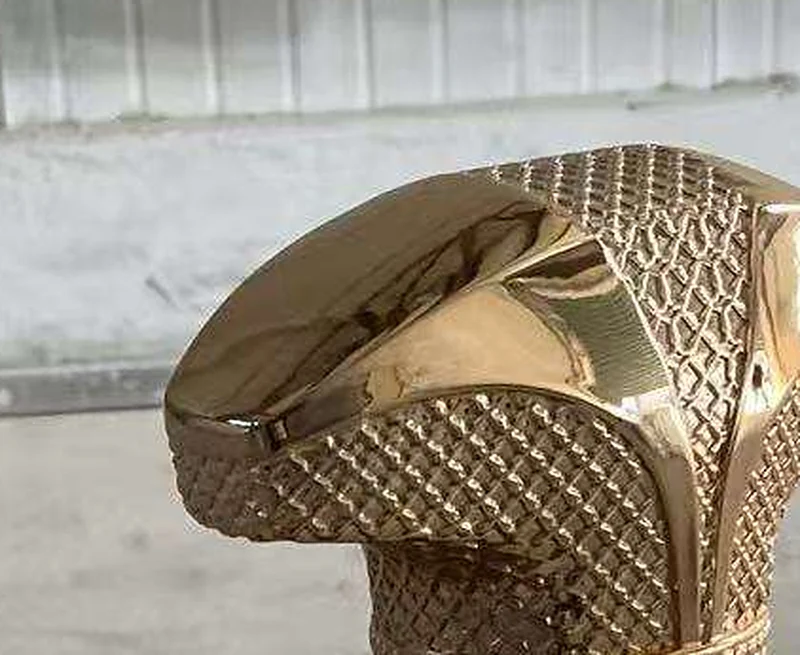
Take a bottle you can hold in one hand, roughly 80 mm of glass, and scale it to 0.4 m and you are working at about five times. Every detail grows with it. A 1 mm stone becomes 5 mm, which is big enough to count facets on, see the culet, and tell whether the back is cut or simply domed with foil behind it.
A domed stone with foil reads convincingly at 1 mm. At 5 mm it looks like a bead. So the stones on a model this size are chosen for what survives at 5 mm: a deeper colour body, a defined girdle, facets cut rather than moulded. We do not put real stones in a retail prop. A real stone of that size costs more than the plated cap around it, and anything that can be prised out of a display eventually is.
Plating copies the surface underneath
Gold does not add detail. It reproduces whatever sits under it, which is why the carving has to be finished before the part goes near the tank. The cap here is a cast part: two hatched wings, polished lobes between them, a beaded ring at the collar. Each of those surfaces is sanded, cleaned and checked by hand first. A scratch you cannot see on a beige blank comes back as a dull streak once there is metal over it.
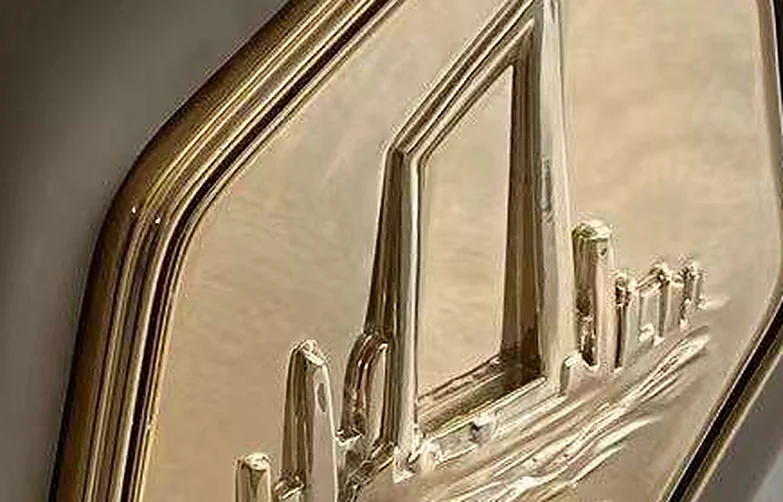
Edges behave the other way. Plating builds on corners, so a cast edge that comes off the mould crisp goes back slightly rounded. File it to a knife edge and it returns sharp enough to catch a sleeve. We work between the two, which is why the border on the plaque looks moulded rather than machined.
The lattice is the honest test
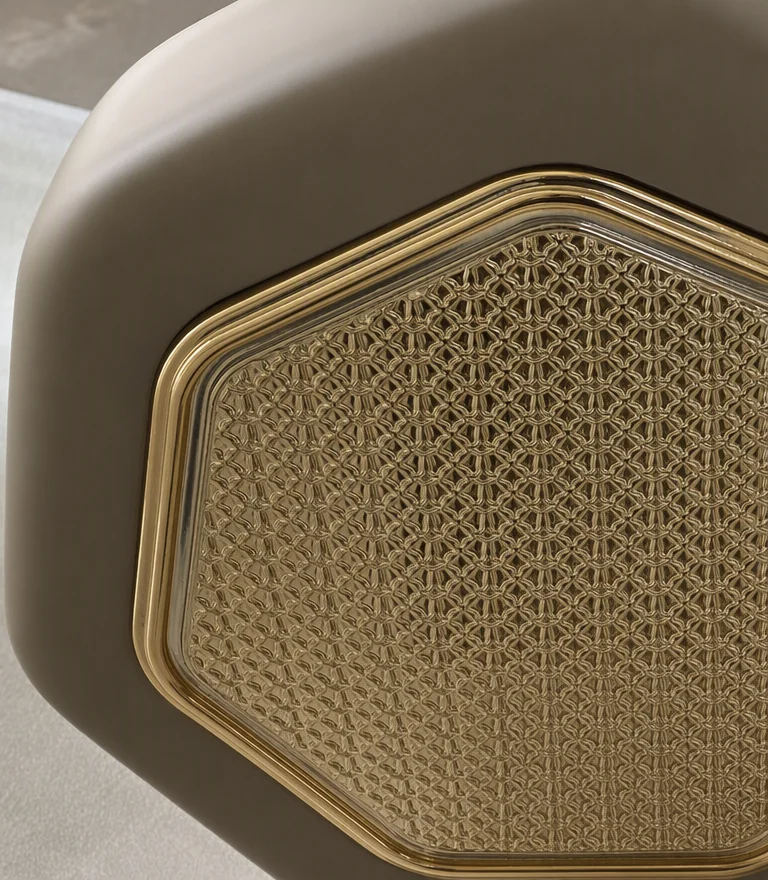
Turn the piece around and there is a panel of gold lattice, hundreds of cells across a face the size of a palm, each cell sitting inside a raised rim. This is where a soft mould shows itself. If the cells are not cut deep enough the plating bridges them, the bottom of the panel goes solid, and polishing will not bring the pattern back.
We look at that panel under raking light at 45° before plating. Raking light finds a shallow cell that a straight-on look hides, and it is cheaper to re-cut a mould than to strip a plated part and start again.
Two parts, two baths, one gold
Cap and plaque are plated as separate parts, sometimes on separate days. Gold drifts with bath chemistry, current and time in the tank, so two runs without a reference leave you with two golds on the same bottle. Almost nobody can name the difference. Almost everybody sees it. We plate both against one approved sample and compare them side by side under the light the piece will actually sit in, which in retail is usually a narrow spot at close range.
Where this stops working
The cap is the part that takes the hit in transit. It is built as a separate component partly for that reason: a knocked cap can be re-made without rebuilding the body, which matters if a crate is going to a trade fair and has to look right on the opening morning.
Gold at the collar will wear. Any plated surface that staff handle daily goes dull along the contact line within a season, and a piece wiped every morning wears faster than one that is only dusted. There is no coating that fixes this; the honest answer is to plan for a re-plate or a second cap if the piece is in daily use.
You cannot polish after plating either. Polishing cuts through the layer and leaves a patch that will not take colour again, so all finishing happens before the bath. At 1 m the same stone has to grow or disappear: detail that reads at 0.4 m is invisible at 1.1 m from a normal viewing distance, and we would rather drop a detail than let it mush.
And the plaque ships blank. Where the mark is yours, or you can show you are authorised to reproduce it, we cast the relief and plate it with the cap. Where rights are unclear we ask at quoting rather than quietly copy something.
Specs at a glance
| Height shown | 0.4 m / 1.5 ft; built to your size |
|---|---|
| Body | Fiberglass shell, matte beige, one piece |
| Cap | Cast, hand-finished, gold-plated; hatched wings, polished lobes, beaded collar |
| Plaque | Cast relief, gold-plated; raised border, skyline in low relief |
| Stones | Artificial, colour-matched, set into a seat cut before plating |
| Marking | Plaque ships blank unless rights are confirmed |
| Minimum order | from 1 piece |
| Sampling | around 15 days for the first piece |
| Production | 20-30 days, depending on order quantity after deposit |
Common questions
Are the stones real?
No. They are artificial stones colour-matched to the plating. A real stone in a retail prop is a theft risk, and at 60 cm it buys nothing a visitor can see.
Will a stone come loose?
It sits in a seat with the rim over it rather than on a bed of adhesive, so the plate is doing the holding. Handle the cap by the collar rather than by the ornament and there is very little to go wrong.
Can a scuff be touched in?
On a flat area, usually yes. At the collar, where the wear is a band rather than a spot, the part normally needs re-plating, which is why the cap is designed to come off.
Can the plaque carry our logo?
Yes, where you own the mark or can show authorisation. Send the artwork and we will cast the relief and plate it to match the cap.
If you have a bottle with a carved cap, the two useful things to send are a photo of the cap with a ruler against it and one of the plaque shot straight on. From those we can say which details survive at your size and which will have to change before anyone cuts a mould. Start with the factice perfume bottle models we build, or read how the sameplated label and sculpted capare made on a flocked body, and howa bottle is scanned and reproduced before any of this work starts.