
2026-10-29 · 8 min read
What Fits Inside an Opened Shell Display Prop
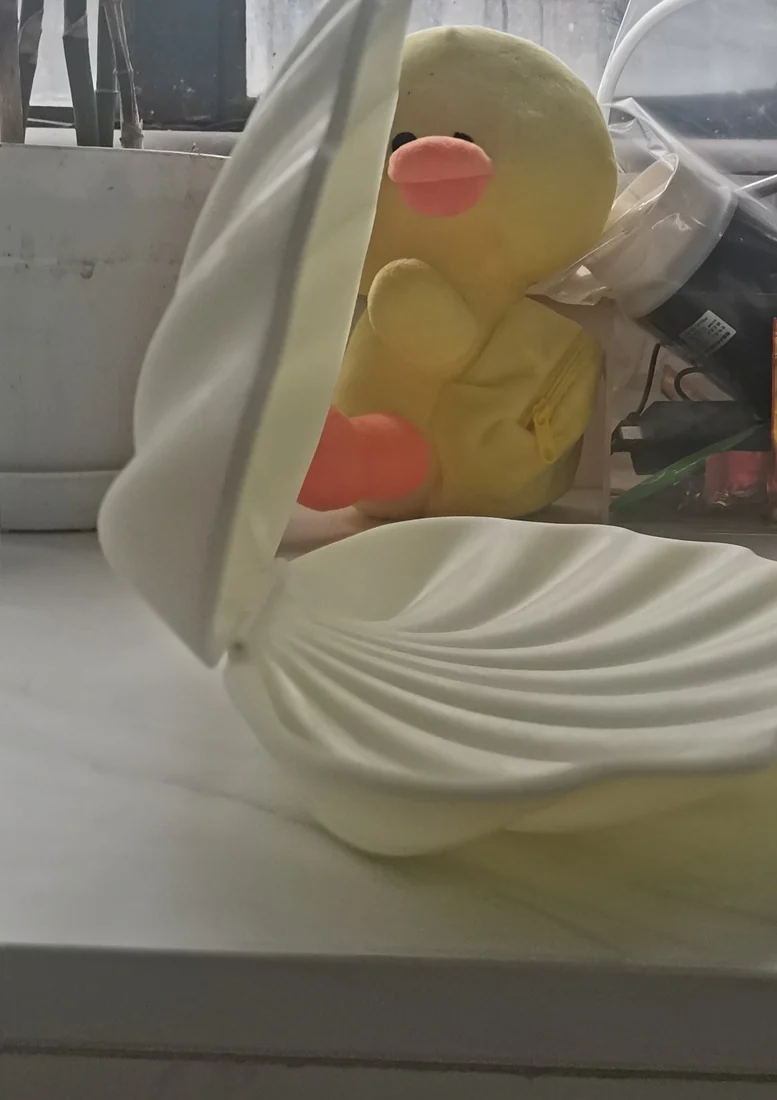
Most shell props are briefed from one photograph: the shell standing open, product in front, camera at eye level. That photograph shows one of the three positions the piece actually has, and it hides the only thing that decides whether your product looks right in it. How much of the product ends up below the rim.
The unit in these photographs is a scallop shell in resin, two moulded leaves joined through the middle so it opens like a book. Listed measurements are 0.25 m wide, 0.20 m deep, with the back leaf standing 0.25 m above the hinge. The two leaves are not the same size, which is the first thing to get right: a scallop has one deep valve and one shallow one, and if you make both the same the piece looks pressed rather than grown.
Three positions, three different jobs
Closed, the two dishes turn face to face and the piece reads as a single shell, about 0.25 m across, sitting on its outer face. Nothing is on show. People close it for transport, for storage between windows, and for the moment before a launch when the product is meant to be a surprise.
Part open is the position almost every shop uses. The lid comes up and stays where you leave it, the lower leaf becomes the tray, and the back leaf stands behind the product as a backdrop. The back leaf is 0.25 m above the hinge, which is roughly two and a half times the height of a 100 ml flacon. That ratio is why the bottle reads as sitting inside the shell instead of standing in front of it.
Flat is the position the piece is finished in, and the one that sells it to display managers who need width. Both leaves lie level and you have a double dish: 0.25 m wide, and close to 0.45 m from the tip of one leaf to the tip of the other. Two products side by side, or one product with a card and a tester.
| Closed | Single shell silhouette, about 0.25 m across, nothing visible |
|---|---|
| Part open | Lower leaf carries the product, back leaf stands 0.25 m as a backdrop |
| Flat | Double dish, roughly 0.45 m tip to tip, for two items or one wide arrangement |
| Material | Resin, sprayed finish |
| Reference size | 0.25 m wide × 0.20 m deep, back leaf 0.25 m high |
| Surface options | Pearl white, or a tone matched to the shell itself |
| Sizes | Made to order, up or down from the reference |
| Minimum order | from 1 piece |
| Sampling | around 15 days |
The well is shallow, and that decides the brief
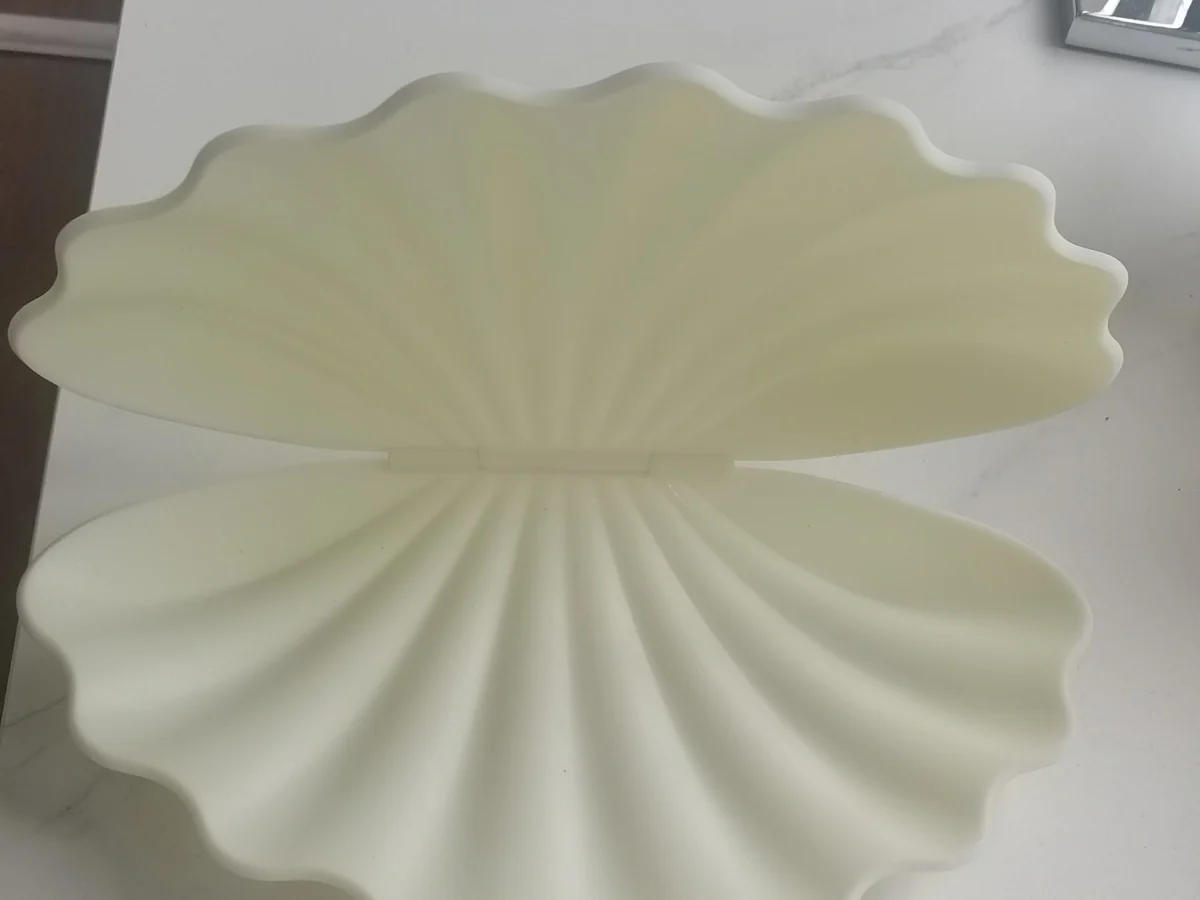
A shell dish is not a tray with straight sides. It follows the ribs: deepest at the umbo where the ribs converge, rising as they fan out, and turning up into the scalloped lip. So the flat area a product can actually stand on is small and central, and it is smaller than the footprint suggests.
That has two consequences worth knowing before you choose the prop.
The first is height. On a 0.25 m shell the dish is shallow, so a standing bottle keeps most of its body above the lip. You get the shell behind the product and around its base, not a nest that swallows it. That is usually what a fragrance brand wants, because the bottle is the thing being sold. If you want the product to sit down inside the shell the way a pearl sits in a real one, that is a deeper cavity, a thicker wall, and the two leaves stop closing cleanly. Ask for it as a different piece.
The second is weight and centre of gravity. A wide, low jar will sit anywhere in the well. A tall bottle with a narrow foot will stand on the high point of two ribs and rock. It does not fall over on a bench, which is why the problem gets missed at sampling and shows up in a window when a customer brushes past.
Holding the product: four ways, in order of how much they cost you later
Nothing. The product rests in the dish. It is the cheapest option and the right one for a wide-based jar or a compact. It also means the display can be re-merchandised with whatever the shop has in stock, which display managers value more than buyers expect.
A shallow recess. We mould or rout a seat the diameter of the product's base into the lower leaf. Invisible, and the bottle cannot walk. The cost is flexibility: the recess is cut for one base size, so a bottle change in eighteen months means a new leaf, not a new insert.
A clear acrylic cradle. A small bracket that follows the base and rises a couple of centimetres up the body. Visible if you look for it, invisible from two metres. It can be re-cut for a new bottle without touching the finished shell, which is why we recommend it for ranges that get refreshed.
A pin or a peg. For a bottle with a foot recess, or for a card that has to stand at an angle. Discreet and positive, and it assumes a hole in the product or in the printed piece. Tell us if that is acceptable, because it is not always.
In a window, add a tether point. A prop that can be picked up will eventually be picked up, and a shell at 0.25 m is light enough to walk.
Pearl white, or the tone of the shell itself
Both are sprayed over a moulded resin leaf, so the difference is not the material but what the coat does with light coming across the ribs.
Pearl white is a white base under an interference coat. It throws a cool highlight down each rib and lifts the edge of the shell off the wall behind it, which separates a clear glass bottle from the prop. Under warm shop light it drifts towards cream, so it has to be approved under your lighting and not ours. It also shows handling. A surface wiped every morning with a general-purpose cleaner dulls before one that is dusted.
A tone matched to the shell runs from warm cream to bone, with the outer face kept drier and less reflective than the inside. It reads as an object rather than as a product, sits quietly next to amber glass and ceramics, and hides fingermarks that pearl white will not. The trade-off is that it disappears against a warm, low-contrast background, which is most hotel lobbies.
One caution about judging either from a screen. The two bench photographs in this article were taken on different days, one by a window in daylight and one under indoor light, and the white balance is not the same. Do not read them as a colour comparison. A finish like this is approved from a physical sample in the room where the piece will stand, and that is what we send before a production run.
The coating side of this, why pearl is the slow part of the build and how the overlap is run along the ribs rather than across them, is written up inthe piece on how the hinge and the pearl coat are made.
From a real shell to two leaves, then to your size
The most reliable starting point is the shell itself, posted to us. We scan it, keep the asymmetry, and work from the scan rather than from a library model, because ribs that mirror each other are the fastest way to make a real object look manufactured.
Photographs work when a shell cannot travel, with two conditions: something for scale in the frame, and a straight-on view of the closed face, since that is the view the piece will be judged from on a shelf. What photographs do not give us is the lip. The scalloped edge is thin, curves in two directions, and is the first place a photo-based model goes soft.
The scan is the beginning, not the drawing. Three things get designed after it: where the piece splits into two leaves, how the hinge pad sits in the umbo so nothing stands proud when it closes, and how thick the wall is where hands will pick it up. None of those exist in the scan of a real shell, and all three decide whether the piece closes.
Size is where most briefs go wrong. The reference here is 0.25 m, and at that size the leaf can be thin and the hinge small. Take the same drawing to 0.6 m and the proportions stop working: the leaf sags between the ribs under its own weight, and the hinge is carrying a lid with four times the surface. We change the section, add fixing points and use a heavier hinge rather than scaling the numbers. So when you ask for a size, tell us the finished size and what will stand in it. The quote comes back as a section, not a zoom.
On rights: we reproduce shells and props that you own or are authorised to reproduce, and we ask for that in writing before tooling starts. A shell you picked up yourself is fine. A branded prop belonging to someone else is not. Pieces ship unbranded.
Where this piece will not work
The raised leaf is a backdrop, not a shelf. Put weight on it, or use the open shell as a bracket, and the load path changes completely; the hinge is display hardware and it is not drawn for that. The finish is an interior finish, so permanent direct sun will shift it and outdoor use is a different brief. And the piece will not close over a tall product. If your plan is a case that opens to reveal the bottle still standing inside, say so at the start, because that is a deeper cavity and a different hinge, and we would rather quote it once.
What we need to quote
Four things, and the shell is the only one that can be late.
- The reference. The shell itself, or photographs with a scale in the frame. A scan or a CAD file is better still.
- The size and the surface it stands on. Counter, shelf, plinth or window floor. A 0.25 m shell and a 0.6 m shell are different builds.
- What goes inside, with its height and weight. That single answer decides the fixing, and it is the one we get least often.
- Finish target, quantity, destination and date. The destination sets the packing, and the date tells us whether sampling fits before it.
Sampling takes around 15 days and production runs 20-30 days, depending on order quantity. Minimum order is from 1 piece. Send the shell or the photographs and we will come back with a size drawing and a fixing recommendation before anyone talks about price. Thedisplay props range shows what else is built the same way.
Common questions
Can the shell close with the product still inside it?
Not on this build. The two leaves are dished, so they meet face to face and close over nothing but air. A closed case that holds a product needs a deeper cavity, a different hinge and a thicker wall, and we quote it as a separate piece rather than as an option on this one.
Can you scan our own shell and make it three times the size?
Yes, if you own the shell or are authorised to reproduce it. A scan gives us the surface, including the asymmetry that makes a real shell read as real. Scaling it up is a drawing job, because the wall, the hinge and the fixing points all have to change with size. Tell us the finished size and where the piece will stand, and we come back with a section, not a zoom.
Pearl white or the shell colour: which reads better on a counter?
Pearl white throws light back and separates the product from the prop, which suits clear glass and metal caps. A tone matched to the shell itself sits quieter and hides handling marks, which suits amber glass and ceramics. Both are sprayed finishes, so approve them under your own shop lighting. Minimum order is from 1 piece, and a colour sample takes around 15 days.
Every photograph in this article is an unretouched phone photograph of the bench sample, taken on a windowsill and left as it was, including the clutter. The plush is a bench object used to test whether the dish holds something upright; no client product appears in any of the images. The five-second clip on our Alibaba listing is a design animation rather than footage: it shows the closed, part-open and flat positions, and the geometry matches the part in these photographs. Brand artwork from the original listing has been removed.